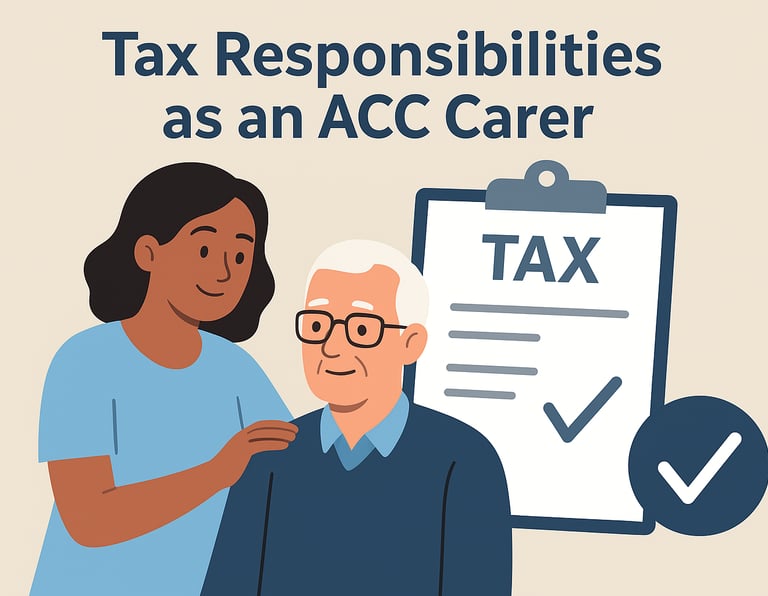
Navigating Tax Responsibilities as an ACC Carer in New Zealand
If you're an ACC carer in New Zealand, it's crucial to understand your income tax obligations to ensure compliance and avoid penalties. This guide provides essential information on tax rates, required forms, record-keeping, and claiming expenses.
If you're providing care to an ACC client—whether as a self-employed individual or through direct payments from ACC—it's essential to understand your tax obligations to ensure compliance and avoid potential penalties.
🧾 Understanding Your Tax Status
As an ACC carer, your income is typically subject to schedular payments, which are taxed at a standard rate of 10.5%. However, you have the option to choose a different tax rate by completing the Tax rate notification for contractors (IR330C) form. This form allows you to specify your preferred tax rate, which your payer will apply to each payment. If you don't submit this form, ACC will default to the non-declaration rate of 45%.
📝 Required Documentation
To ensure you're paid and taxed correctly, complete the following forms:
ACC84 – How would you like us to pay for your care?
This form must be filled out for each client you provide care for. Your client also needs to complete certain sections.IR330C – Tax rate notification for contractors
This form allows you to specify your tax rate.
Submit both forms to your payer—either ACC or the person you're caring for. Failure to provide these forms may result in higher tax deductions and potential delays in payment .
📚 Record-Keeping Requirements
Maintaining accurate records is crucial for tax purposes. If you're self-employed and receive payments directly from your client, you're required to keep detailed records for 7 years, including:
The date and amount of each payment received.
The name of the person who made the payment.
These records are vital for completing your annual tax return and ensuring you're not overpaying taxes .
🚗 Claiming Expenses
As a self-employed carer, you may be eligible to claim certain expenses:
Vehicle Expenses: If you use your vehicle to transport clients—such as taking them to medical appointments—you can claim vehicle-related expenses. However, commuting from home to work is considered private use and isn't claimable .
ACC Levies: You can claim ACC levies paid on your carer income as an expense.
These deductions can reduce your taxable income, potentially lowering your overall tax liability.
📅 Annual Tax Return
At the end of the tax year, you'll need to file an Individual Income Tax Return (IR3). This return will include your schedular payments and any tax credits. If your annual income from all sources is $9,500 or less, you may not be required to file a return .
🧾 Special Considerations
Payments to Family Members: If you're paying a family member, such as a partner, from your ACC payments, these amounts are considered 'family income.' They'll be included when calculating your Working for Families Tax Credit entitlement .
Using an Agency: If you employ an agency to provide care, the agency is responsible for tax deductions and record-keeping. However, if you're paying the agency directly, you must manage the tax responsibilities yourself .
✅ Final Tips
Submit Forms Promptly: Ensure you complete and submit the ACC84 and IR330C forms as soon as possible to avoid higher tax deductions.
Maintain Accurate Records: Keep detailed records of all payments and expenses for at least 7 years.
Consult a Tax Professional: If you're unsure about your tax obligations or need assistance with your tax return, consider seeking advice from a tax professional.